
The coming decade will see a significant investment in digital transformation for the vast majority of organizations looking to drive success. But successful digital transformation relies on leveraging software to help employees acclimatize to new and evolving technology.
This poses a challenge to employee productivity, as workforces across the globe will be forced to adapt to new technology in their day-to-day roles. Ideally, implementation of such tech requires an approach that impacts productivity as little as possible. That's why companies are increasingly turning to digital adoption platforms that facilitate the process and support employee efficiency rather than hampering it.
What is a Digital Adoption Platform?
A digital adoption platform (DAP) sits on top of an existing software application, offering users insight and guidance that helps them to adjust to the software application, providing information on key tasks and functions. With a DAP, companies can introduce new software to their ecosystem without losing productivity that comes from unfamiliarity with technology.
Technology is evolving quickly, and the most productive, successful companies adopt new tech to drive growth and employee success. As a result, a digital adoption platform is key to ensuring that your teams are getting the biggest possible benefits from the software applications that they use.

What Are the Main Features of a DAP?
Digital adoption platforms may offer different features depending on the product and feature set of a particular provider. In general, though, DAP functionality includes some of the following central features:
Product tour: Progressive tours of a software product that you'll see the first time you access the application, or upon release of a new feature.
Step-by-step guides: Detailed walkthroughs on how to complete a given task at each step in the journey.
Detailed analytics: Management information detailing user usage of the application.
Language support: The capability to translate a software's language into multiple different languages.
Company announcements: Pop-up announcements that can provide general company information or details on a new feature.
Tooltips: Additional information that's provided when a user hovers over a particular feature.
The Best Digital Adoption Solutions 2022
According to a recent report from Gartner, around 70% of organizations will be using a digital adoption platform by the year 2025 to overcome user challenges, and as a general user onboarding tool. However, if your company is looking to adopt DAP software for the first time, you need to know where to begin.
With such a broad range of solutions on the market, how do you know which is the best DAP software? Fortunately, websites such as G2.com provide detailed social proof that can help to guide you in making a decision.
Gartner names a number of existing solutions, which are detailed below. At the time of writing, some of those solutions have also been ranked in a G2 list of the "Top 20 Digital Adoption Platforms." Excluding solutions that were unranked, Gartner suggests that these are some of the leading DAPs on the market as of now:
Appcues: 4th
Whatfix: 5th
Usetiful: 7th
Pendo: 9th
WalkMe: 12th
Apty: 13th
Spekit: 14th
Ideally, your organization should stick to the beaten path and select a digital adoption solution that has already been tried and tested by the organizations that came before you. But that still leaves a number of options at your disposal.
Choosing a Digital Adoption Solution
One of the most important considerations when choosing a DAP is usability. Your digital adoption solution intends to simplify user onboarding and reduce support tickets, so usability should be at the forefront of your mind.
As noted above, websites like G2 can be a useful source of social proof that can help to shape your decision, as they report on the learnings of companies who have already implemented a DAP.
At the time of writing, G2 ranks Usetiful as the second most easy-to-use digital adoption platform on the market, putting it ahead of all DAPs mentioned in Gartner's report.
Usetiful has also garnered a range of other accolades from G2 and Crozdesk across 2022, including "Most Implementable," "Fastest Implementation," and "Best Meets Requirements." Usetiful has also been recognized as the Momentum Leader in DAP for Winter 2023 by G2 and has been named a continuous High Performer since Winter 2022.
Usetiful as a User Onboarding Tool
Usetiful has been designed to be as user-friendly as possible from a user onboarding point of view. Set up product tours to introduce new users to the most important parts of a system and provide solutions.

Usetiful as an Employee Onboarding Tool
Employees come into your organization full of optimism and eagerness to learn, so don't let your employee onboarding process be tedious.

Your employees can even access Usetiful from both desktop and mobile devices, the latter of which is not seen in many of the tools named in Gartner's report.
Usetiful as a Product Adoption Tool
A myriad of features makes Usetiful the perfect product adoption software for your organization. The no-code approach to campaign management makes things simple, while offering in-app notifications, ways to promote new software features, and feedback-gathering tools.
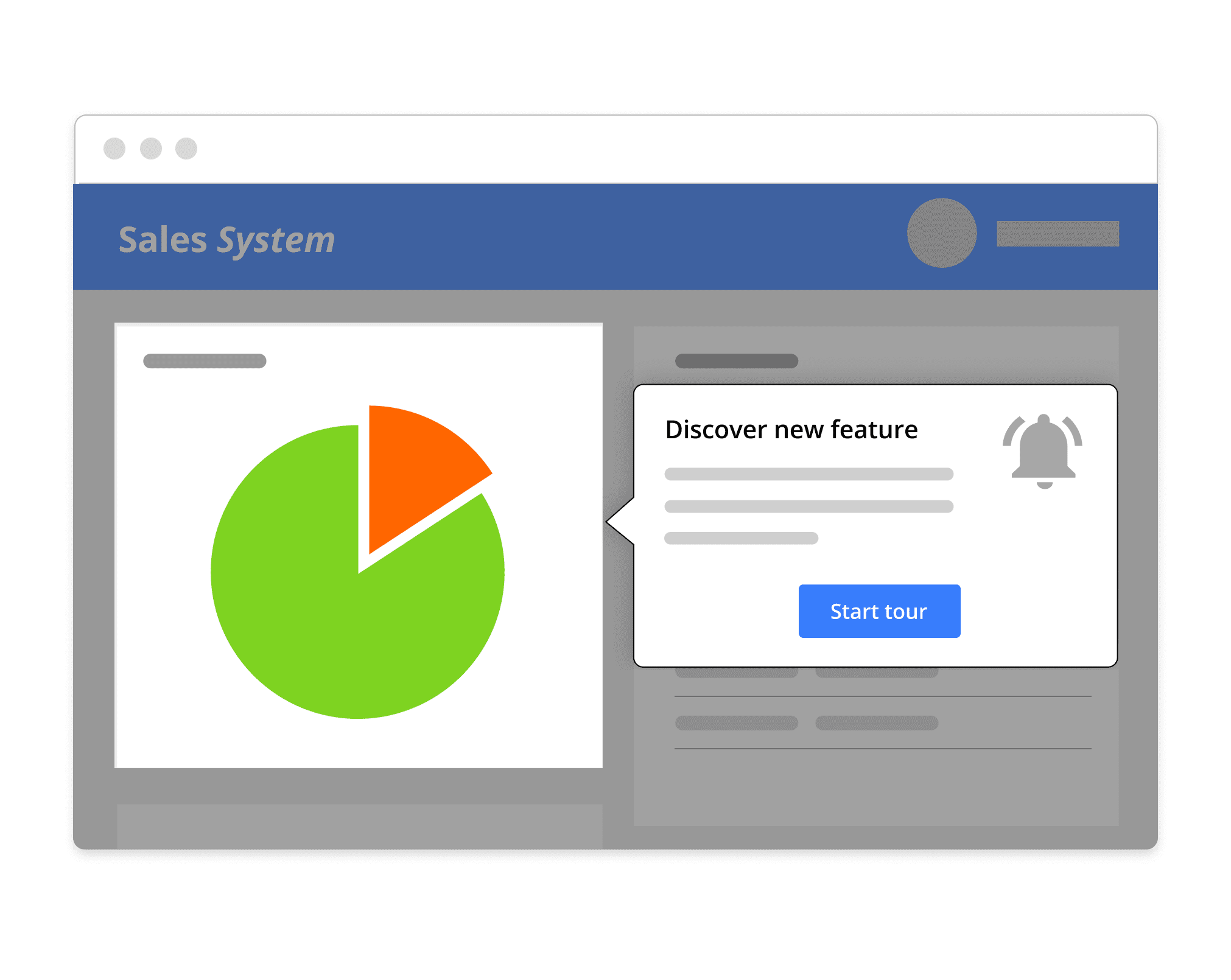
Usetiful also has a focus on user retention, offering the ability to provide early access features to selective users or introduce small, unintrusive tutorials for more complex features so that your users are always learning and never getting bored.
Why Usetiful?
Users are already seeing the benefits of Usetiful, particularly when compared to many of the competitors named on G2's rankings; the social proof speaks for itself:
"Within hours on the free trial, I was able to recreate the most important tour I currently pay a lot more for in Intercom. If you're familiar with setting up tours in Intercom it's a piece of cake to do it here. I love intercom, but I'm growing tired of being tied into a monolithic and high-cost product." - G2 Review
"I found Usetiful to be the most accessible, affordable, and user-friendly. Usetiful is a great solution for SMBs that want to get the most out of their money." - G2 Review
"Usetiful is one of the most intuitive digital adoption tools I've come across. For us, it solves a key problem. We have a large user base that is inflated by free users. Usetiful only charges us based on the number of users who actually see the smart tips or product tours. Coupled this with all the best in class features." - G2 Review
Usetiful: Get Started for Free
Overwhelmingly positive social proof supports the simplicity and flexibility of Usetiful as a user onboarding tool. What's more, you can get started for free to quickly find out how much time Usetiful can save your workforce.